Is Personal Finance Mandatory in Your State Yet? The Complete 2026 State-by-State Map
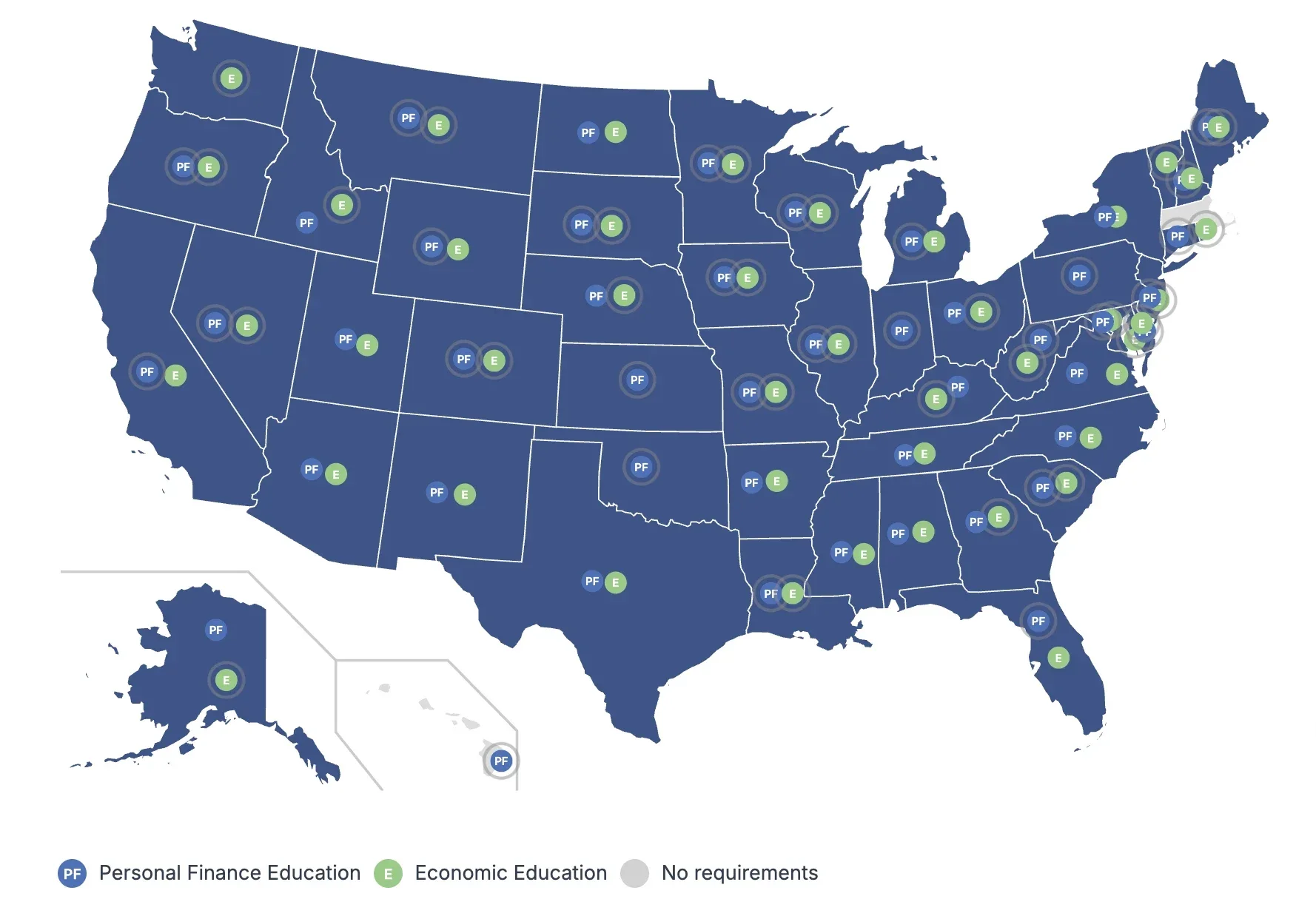
Key Takeaways
30 states now require a standalone personal finance course to graduate high school — up from just 17 states in 2022
Counting states that fold personal finance into another required course (like economics), the total rises to 39 states
Utah was the first state to require it, back in 2008, and still ranks #1 nationally for financial education access
A 2025 university study found students required to take a standalone course had meaningfully higher credit scores through age 34 than students who weren't
California, Texas, and 18 other states are still phasing requirements in through 2034 — see exactly where your state stands below
As of 2026, 30 U.S. states require high school students to complete a standalone personal finance course before they can graduate — nearly double the 17 states that had a requirement in place just four years ago. If you're a parent trying to figure out whether your teen's school is actually required to teach this, or you're simply wondering how your state compares, here's the complete, current picture.
The Complete List: Every State's Requirement and Start Year
The table below lists all 30 states with a standalone personal finance graduation requirement, alongside the first graduating class each requirement applies to. A handful of states — Missouri, Tennessee, and Utah among them — have had this in place for over a decade. Others, like California and Nebraska, are still years away from full implementation.
Utah: 2008
Missouri: 2010
Tennessee: 2013
Virginia: 2015
Alabama: 2017
Mississippi: 2022
Iowa: 2023
North Carolina: 2024
Rhode Island: 2024
Ohio: 2026
Connecticut: 2027
Florida: 2027
Kansas: 2027
Louisiana: 2027
New Hampshire: 2027
Oregon: 2027
South Carolina: 2027
Georgia: 2028
Indiana: 2028
Michigan: 2028
Minnesota: 2028
West Virginia: 2028
Wisconsin: 2028
Colorado: 2030
Delaware: 2030
Kentucky: 2030
Pennsylvania: 2030
Texas: 2030
California: 2031
Nebraska: 2034
Sorted by year the requirement takes effect. Source: Next Gen Personal Finance (NGPF), 2026 State of Financial Education Report.
Already required (class of 2026 or earlier): 10 states — Utah, Missouri, Tennessee, Virginia, Alabama, Mississippi, Iowa, North Carolina, Rhode Island, and Ohio.
Still phasing in (class of 2027 through 2034): 20 states, led by a wave of requirements taking effect in 2027 and 2028.
The 20 States Without a Standalone Requirement
If your state isn't in the table above, it currently has no standalone personal finance graduation requirement: Alaska, Arizona, Arkansas, Hawaii, Idaho, Illinois, Maine, Maryland, Massachusetts, Montana, Nevada, New Jersey, New Mexico, New York, North Dakota, Oklahoma, South Dakota, Vermont, Washington, and Wyoming. That doesn't necessarily mean zero financial education — some of these states still require personal finance content to be folded into another required course, such as economics. It's just not guaranteed to be its own dedicated class.
Why "Standalone" Specifically Matters
The distinction between a standalone course and one merged into economics or social studies isn't just semantics — it shows up in outcomes. A 2025 study by researchers at Montana State University and the University of Wisconsin–Madison tracked young adults into their thirties and found that those required to take a dedicated personal finance course had meaningfully higher credit scores through age 34, along with fewer serious credit delinquencies, compared with peers who weren't. Folding personal finance into an existing course like math or social studies, by contrast, showed no measurable improvement in the same research. A required standalone class, it turns out, is doing something a few embedded lessons inside another subject can't.
The Five States Setting the Bar
Beyond simply having a requirement, some states have built genuinely strong financial education systems around it. A 2026 ranking of state financial education policies from Intuit — scoring states on graduation requirements, access, and implementation — put Utah, Wisconsin, Nebraska, Rhode Island, and Virginia at the top nationally. Utah's position isn't a surprise: it was the first state in the country to require a standalone personal finance course, back in 2008, and nearly two decades later it still leads on access and instructional support.
The Big Three Are Just Getting Started
Texas and Florida aren't the states that started this trend, but they're now the first of the nation's three most populous states to adopt it — meaning millions of additional students will graduate with formal personal finance education once their requirements take full effect. Florida's begins with the class of 2027; Texas follows with the class of 2030. California, the most populous state of all, has also passed a standalone requirement, first applying to the class of 2031. Once all three are fully phased in, a substantial share of the entire U.S. high school population will have gone through a dedicated personal finance course — a very different national picture than existed even five years ago.
How U.S. Teens Compare Globally
Even with the requirement wave underway, the U.S. still sits only just above average internationally. The OECD's 2024 PISA Financial Literacy Assessment scored U.S. 15-year-olds at 504, just edging out the OECD average of 498. Several education systems — including Denmark, Poland, Portugal, Austria, and parts of Canada — scored meaningfully higher, while the U.S. outperformed countries including Spain, Italy, Norway, and the Netherlands. The takeaway: state mandates are moving the U.S. in the right direction, but they haven't yet closed the gap with the world's strongest financial education systems.
A Law on the Books Isn't the Same as a Skill in Practice
Even where a requirement exists, it's typically one semester, half a credit, covering the basics — budgeting, saving, credit, and debt at a foundational level. The 2026 National Financial Literacy Test found teens aged 15–18 averaging just 64% overall, with younger students (10–14) averaging only 57%. A mandated class is a genuine floor, not a ceiling. Getting from "passed the required course" to "can actually evaluate a real financial decision, defend a budget, or understand risk in an investment" tends to take more applied, hands-on practice than a single semester provides — which is exactly the gap structured, practical financial and business training is built to close, regardless of what your state currently requires.
Frequently Asked Questions
Does my state require personal finance to graduate high school?
Check the table above — 30 states currently require a standalone course, ranging from Utah (in place since 2008) to Nebraska (phasing in by 2034). If your state isn't listed, it doesn't yet have a standalone requirement, though it may still cover personal finance within another required course.
What's the difference between a "standalone" and an "integrated" requirement?
A standalone requirement means personal finance is taught as its own dedicated course. An integrated requirement means the content is folded into an existing course, like economics. Research shows standalone courses produce measurably better long-term financial outcomes than integrated ones.
My state isn't on the list — does that mean my teen gets zero financial education?
Not necessarily. Some states without a standalone requirement still mandate personal finance content within another course. It does mean your teen isn't guaranteed a dedicated class, so it's worth checking directly with their school.
Is one semester of a mandated course actually enough?
It's a solid foundation, but national testing shows the average teen still scores well below full proficiency even in states with a requirement. A single semester tends to cover core definitions rather than the applied, real-world practice that builds lasting financial confidence.
Which state was first to require personal finance for graduation?
Utah, in 2008. It remains the top-ranked state nationally for financial education access and instructional quality.
Whether or not your state has caught up yet, IFA's Foundation Series covers the applied side of financial literacy — real decisions, real case work, not just definitions — that even a mandated course often doesn't reach.
Sources: Next Gen Personal Finance (NGPF) 2026 State of Financial Education Report; Council for Economic Education (CEE) 2026 Survey of the States; Intuit 2026 state financial education policy analysis; Montana State University / University of Wisconsin–Madison (2025); OECD 2024 PISA Financial Literacy Assessment; 2026 National Financial Literacy Test.