Genius Olympiad's Business Track (Now Called Entrepreneurship): The STEM Competition Most Entrepreneurial Teens Overlook
Key Takeaways
What it is: The business track of the GENIUS Olympiad, now officially called Entrepreneurship, where students pitch a financially realistic business that solves an environmental problem
Who can enter: Students in grades 8 to 12 (minimum age 13) from any country, alone or in a team of two, as long as they haven't started university
2027 dates: Applications open in December 2026, the deadline is March 1, 2027, finalists are announced by March 25, and the in-person finals run June 7 to 12, 2027, at St. John Fisher University in Rochester, New York
What you submit: A three-minute pitch video, not a full written business plan. Finalists then pitch for up to five minutes and face four to five minutes of questions from judges
How it's scored: Out of 50 points. Innovation, feasibility and scalability, and overall strength under questioning are worth 10 each, and four other criteria are worth 5 each
What it costs: $75 per project to apply, then $695 per participant if selected ($495 if you book your own hotel). Chaperones pay the participation fee too
Your odds: In each discipline, the 2026 awards went to one Grand winner plus roughly the top 40% of presenters, and Entrepreneurship is one of the smaller disciplines
Picture a fifteen-year-old sitting at the back of her uncle's tailoring shop at closing time. She watches him sweep a sack of fabric offcuts towards the bin, the way he does every evening, and something snags in her mind. That's a lot of cloth. Where does it end up? Who might want it? Would they pay?
Most of us would shrug and move on. A few teenagers can't. They keep tugging at the thread until it turns into a question about customers, costs and the planet all at once. Asked seriously, that question is a business. And every June, a university campus in Rochester, New York fills with teenagers from dozens of countries who have each tugged at a thread like that, along with a panel of judges ready to ask them hard questions about it.
That gathering is the GENIUS Olympiad. The part of it built for young founders is the one hardly anyone talks about.
In short: the Genius Olympiad's business track, which the organisers now call Entrepreneurship, is a pitch competition for students aged 13 to 18 who want to build a financially realistic business that solves an environmental problem. You can enter alone or with one teammate, submit a three-minute video, and, if you're selected, present in person to a panel of judges. The 2027 finals run June 7 to 12. The rest of this guide fills in the detail: what it costs, how the judges score you, and what kinds of ideas actually win.
What is the Genius Olympiad business track?
The business track is the entrepreneurship side of an international competition about environmental issues. Older guides call it Business, while the organisers' current name for it is Entrepreneurship. It's the same discipline, so if you search for either name you'll find pieces of the same story.
GENIUS stands for Global Environmental Issues and Us. The Olympiad is organised by Terra Science and Education, a non-profit based in Syracuse, New York, and hosted by St. John Fisher University in Rochester. It's open to students in grades 8 to 12 anywhere in the world and now has nine disciplines: Science, Art, Short Film, Music, Robotics, Entrepreneurship, Speech, Coding and Artificial Intelligence. The organisers' own numbers for 2026 list more than 5,500 applicants from 79 countries and 36 U.S. states.
Entrepreneurship asks something specific of you. Your idea can be a new green product or technology, a more sustainable version of something that already exists, or a social responsibility plan that helps a company or a whole industry shrink its environmental footprint. Either way, you pitch it the way a founder pitches an investor. The numbers have to hold up, the idea has to stand apart from what's already out there, it has to be able to grow, and the environmental benefit has to be something you can measure, not just something you hope for.
Why do so many entrepreneurial teens miss it?
Mostly because of the name on the door. "Genius Olympiad" sounds like a science fair, and the science side really is the biggest part of it. If you're scrolling for business competitions, you'll spot the Diamond Challenge and Blue Ocean long before you stop on something that sounds like it belongs in a chemistry lab. The Olympiad does turn up in some roundups of business competitions, usually with a line or two of description. It's easy to read past.
Here's the part that surprised us. On the official 2026 awardee list, Science entries fill page after page. Entrepreneurship is a different picture: by our count, 26 projects received awards in the entire discipline. Because awards are handed out as a percentage of each discipline's presenters, that likely points to a far smaller field than on the science side, with fewer teams competing for the judges' attention. A smaller room isn't an easier room, because the questions are still hard. But a strong idea has a real chance of being noticed.
There's a second reason teens skip it, and it's more personal. Many look at the environmental requirement and decide their idea "isn't green enough." If that's you, reread the three routes above. A business that helps a restaurant waste less, helps a factory use less energy, or turns scraps into something people want to buy all counts. The requirement isn't a barrier your idea has to clear. It's what makes the idea fit here.
One more rule works in your favour. The organisers allow projects that were entered in other competitions to be submitted without changes, as long as the same project isn't resubmitted year after year without real improvement. A venture concept you built for another contest isn't wasted. It may need an environmental backbone to fit, but you wouldn't be starting from zero.
What kind of idea does the Entrepreneurship track reward?
The official 2026 awardee list is the best evidence we have, because it shows what actually won. A few titles give a feel for the range. A silver went to a project from Indonesia that turns used cooking oil into liquid soap. A South Korean team earned honors for eco-friendly construction materials made from oyster shells. A bronze went to a Greek project built around AI-powered algae facade systems, and another South Korean team took bronze for a spiral-structured vertical solar system designed to get more energy from less space. The Grand award in the discipline went to a project from Vietnam.
Entrepreneurship awardees came from eleven countries and regions, from Paraguay and Panama to Kazakhstan, Slovenia and Vietnam, with the United States and South Korea sending the most. This isn't a competition won by one kind of student from one kind of place.
Look at what those ideas share. None of them needed a laboratory breakthrough. Each starts with something ordinary, like used oil, shells or a rooftop with limited space, and asks who would pay to have the problem solved. That's the instinct this track rewards: an eye for the everyday problem and the discipline to put a price on the answer. A tailor's offcuts, a school canteen's leftovers, a neighbourhood's pile of old electronics. If you can describe the problem in one sentence and the customer in another, you're closer to a pitch than you think.
How does the application work in 2027?
Applications open in December 2026, and the deadline is March 1, 2027 at 9:00 a.m. U.S. Eastern time. You create an account on the official application portal, pay a $75 fee per project (it isn't refundable), and submit a link to a three-minute video, narrated in English and uploaded to YouTube. The video should cover your business pitch, including the product or service, the market and its opportunities, the financial picture and the environmental impact, alongside a screen recording of your slides.
That video is the whole required submission. You can attach supporting documents if you like, but the video carries the application. If you've read older guides describing a business plan of up to fifteen pages and a ten-minute pitch, check them against the current official discipline page, which describes the lighter format above.
A few details save families trouble. Entrepreneurship projects can be prepared by one or two students. You don't need to have launched a company, only to present a realistic proposal that could genuinely be carried out. A prototype isn't required, though it's recommended for new products and technology when you can manage one. All financial figures should be in U.S. dollars. You can submit more than one project, even in different disciplines, but each student presents only one, so you'll choose if you're selected for several. And you can keep improving your project and your presentation right up until judging day.
Finalists are announced by March 25. In 2026 the deadline was extended to March 7, but that's the kind of grace you shouldn't plan around.
One routing note for families outside the United States. Students apply directly to the international competition only if their country doesn't run a national GENIUS Olympiad. The organisers list country-based programmes in places including South Korea, Indonesia, China, Ukraine, Kenya, Pakistan and Azerbaijan, so check the national GENIUS page before you start. Where a national round exists, it comes first.
How do the judges score an Entrepreneurship pitch?
Each pitch is scored out of 50 points, using a rubric the organisers refreshed for 2027. Three criteria carry 10 points apiece: innovation and creativity, feasibility and scalability, and an overall score that rewards a strong grasp of the proposal, honest thinking about challenges and other viewpoints, assumptions backed by evidence, and good answers when the judges push back. Four more criteria are worth 5 points each: the quality of the pitch and communication, competitive advantage, market analysis and opportunity, and environmental impact.
Read that again, because it says something about where your hours should go. Environmental impact carries 5 points out of 50. That doesn't mean it matters little. Without a genuine environmental problem at the centre, you wouldn't be in the room. It means the judges are mostly asking whether this is a real business: whether it's original, whether it could actually be built and grown, and whether you understand your own idea well enough to defend it. Sixty percent of the score rides on those three 10-point criteria.
The overall score deserves special attention, because part of it is decided in the question session. A rehearsed pitch can carry you through five minutes. The four or five minutes that follow show whether you truly understand what you've built.
What actually happens at the finals?
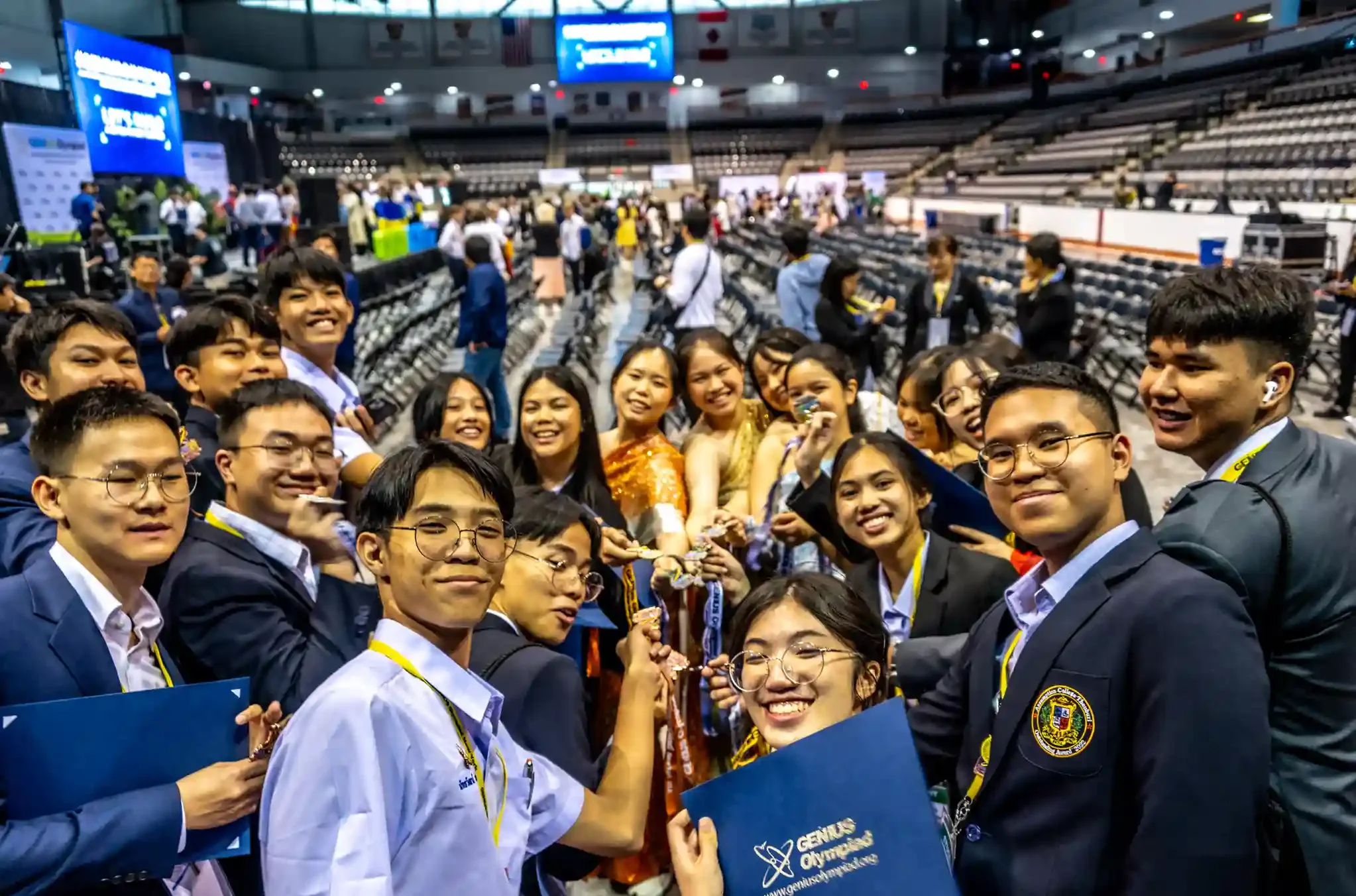
The finals are in person only, June 7 to 12, 2027, on the campus of St. John Fisher University in Rochester, New York. Virtual presentations aren't allowed, and students present in English without a translator.
Your slot is short and entirely yours. You get up to five minutes to pitch, then four to five minutes of questions from a panel of judges. Dress is formal business attire. There are no posters, but you can use slides or video on your own laptop, and you can keep refining your presentation until judging day. Parents and teachers can't come into the judging room. It's you, your teammate if you have one, and the judges.
If you've ever waited outside a closed door while your child did something hard, you know how that feels. The rules are clear that you'll be waiting outside.
Students under 18 need an adult chaperone, whether a parent, teacher, older sibling or relative, who stays with them except during judging. Students who are 18 and haven't started university can attend without one. The participation fee covers a dorm room on campus, meals at the university dining hall, a registration pack with a T-shirt and bag, and a day trip to Niagara Falls that includes the Maid of the Mist boat ride. The organisers also list an international culture fair among the activities, where each country gets a table to share something of its home. After the awards, optional trips head to Washington, D.C. and New York City, or to Boston and New York City with visits to Harvard, MIT, Yale and Princeton.
The week isn't only about five minutes in front of judges. For many teenagers, standing in a room with peers from other continents who are wrestling with their own versions of the same big question is an education in itself.
What are the odds of winning an award?
The Olympiad's award system is generous by competition standards, but it comes after a selection stage. According to the official 2026 awardee list, awards are distributed within each discipline. One Grand award goes to the top project, Gold to the top 5%, Silver to the next 10%, Bronze to the next 10%, and Honors to the next 15%. Add those up and roughly four in ten presenters in a discipline leave with some form of recognition. Only students who present at the finals are eligible, which is why arriving fully prepared matters so much.
Getting to the finals comes first, and it's a real hurdle, so don't read the 40% figure as your odds from application to medal. It's your odds once you're in the room.
Scholarships are a murkier subject. Older sections of the official site, and plenty of guides, describe renewable university scholarships for award winners, tied to the competition's former host. The current rules document doesn't mention any. If scholarships are part of your decision, ask the organisers directly instead of relying on an older article, this one included.
How much does it cost a family?
The official 2027 rules list a $75 application fee per project, which isn't refundable. If your project is selected, the participation fee is $695 for each student and each chaperone, or $495 if you stay in a hotel of your own choosing instead of the university dorms. Extra guests pay $900, or $650 with the hotel option. Optional post-event trips cost $795 for Washington and New York, or $1,045 for Boston and New York.
Here's the maths for a typical family. One student and one parent attending comes to $1,465 in fees with dorm housing ($75 plus two $695 fees), or $1,065 if you book your own hotel, before the hotel bill itself. Flights, visas and local transport are on top. A team of two students travelling with one chaperone pays $2,160 in fees with dorms ($75 plus three $695 fees).
Refunds shrink as the event approaches. Most, though not all, of the participation fee is refundable until May 5, less until June 1, and nothing after that. Visa invitation letters are only available after the participation fee is paid, so international families should plan the timeline early. If you've seen $50 and about $500 quoted elsewhere, that was an earlier cycle. For a wider look at what teen competitions really cost, see our guide to the hidden costs of teen business competitions.
Is the Genius Olympiad business track worth it?
It depends on the student, and we'd rather say that plainly than sell you a dream. No competition guarantees a university place, and the Genius Olympiad isn't as widely known by name as some others. What it offers is more concrete: an independently judged, in-person pitch in front of an international panel, a result that's published on an official awardee list, and months of real work on market research, cost estimates and environmental impact that most teenagers never do.
It also pairs well with other competitions. The Blue Ocean Competition is fully virtual and free to enter. The Diamond Challenge is free to enter and ends with an in-person summit at the University of Delaware. The Genius Olympiad asks for something the others don't: a business with environmental impact at its core, defended live. The deadlines stack neatly, with the Diamond Challenge due January 14, 2027, Blue Ocean around February 21, and the Genius Olympiad on March 1, so a strong concept can travel from one to the next.
And perhaps the best reason has nothing to do with CVs. At some point your teenager will have to explain to a room of strangers why their idea deserves to exist. Whatever the judges decide, that's a good moment to have lived through.
How to start now: a realistic runway to March 1
It's late October. Applications open in December and close March 1, which gives you roughly four months. Here's a rhythm that works backwards from the deadline.
November: find the problem. Spend two weeks talking to real people about something that wastes money, time or resources. A shop owner, a canteen manager, a farmer, a parent who runs a small business. Write the problem in one sentence and the customer in another. If you can't, keep looking.
December: build the numbers. The portal opens. Sketch who pays, how much, what it costs you to deliver, and how you'd know the environmental benefit is real. Use U.S. dollars from the start, since that's what the judges expect. Look honestly at competitors and substitutes, because the rubric rewards students who know what already exists.
January: write the three minutes. Three minutes is very short. Decide the one thing a judge must remember, then build the video around it: the problem, the solution, the market, the money, the impact. Record it, watch it, cut it, record it again.
February: submit early and start practising questions. Upload to YouTube, submit well before March 1 at 9:00 a.m. Eastern, then move straight to practice. Ask someone tough, a teacher or an uncle who runs a business, to play investor for twenty minutes and interrupt you.
March to May: wait, then register. Finalists are announced by March 25. If you're selected, you have until May 5 to register and pay, and visa letters are only issued after payment, so move quickly.
June: pitch. Five minutes, then the questions. Breathe.
If there's a teenager in your house who's always asking why things get wasted, or why they're done the hard way, this might be their room.
Frequently Asked Questions
Is the Genius Olympiad business track the same as the Entrepreneurship track?
Yes. The GENIUS Olympiad discipline that older guides call Business is now officially named Entrepreneurship. Students pitch a financially realistic business that addresses an environmental problem, either alone or in a team of two. The competition is organised by Terra Science and Education and hosted by St. John Fisher University in Rochester, New York.
Who can enter the Genius Olympiad Entrepreneurship track?
Students in grades 8 to 12 from any country can enter, as long as they're at least 13 years old at the time of the event and haven't started university. Entrepreneurship projects can be prepared by one or two students, and students under 18 must bring an adult chaperone to the finals in Rochester.
Does the business idea have to be about the environment?
Yes. Every GENIUS Olympiad project must connect to an environmental or sustainability issue. In Entrepreneurship, that can mean a new green product or technology, a more sustainable version of an existing product or service, or a social responsibility plan that helps a company or an industry reduce its environmental impact.
Do we need a prototype or a registered company?
No to both. Students present a realistic business proposal rather than a launched company, and a prototype isn't required, though it's recommended for new products or technology when possible. The pitch does need to show that the idea could realistically be carried out, with all financial figures converted to U.S. dollars.
Is the Genius Olympiad online or in person?
The application is online, but the finals are in person only. Finalists present in English at St. John Fisher University in Rochester, New York, from June 7 to 12, 2027. Virtual presentations aren't allowed, and students can't use translators during judging.
When is the 2027 Genius Olympiad deadline?
Applications open in December 2026, and the application deadline is March 1, 2027 at 9:00 a.m. U.S. Eastern time. Finalists are announced by March 25, and participant registration closes May 5. The 2026 deadline was extended to March 7, but families shouldn't plan around an extension.
How much does the Genius Olympiad cost?
Applying costs $75 per project. Selected students and their chaperones then pay a $695 participation fee each, or $495 if they book their own hotel instead of the campus dorms. Flights, visas and optional trips are extra. A student attending with one parent pays $1,465 in fees with dorm housing.
How is the Genius Olympiad Entrepreneurship track judged?
Pitches are scored out of 50 points. Innovation and creativity, feasibility and scalability, and an overall score that includes answers to the judges' questions are worth 10 points each. Pitch quality, competitive advantage, market analysis and environmental impact are worth 5 points each.
Can a project from another competition be reused?
Yes. The official rules allow projects entered in other competitions to be submitted to the GENIUS Olympiad without changes. The same project can't be resubmitted in consecutive years without significant improvement, and it still needs a genuine environmental focus to fit the Entrepreneurship track.
Can parents watch the judging?
No. Parents, teachers and other students aren't allowed in the judging room, which is limited to the presenting students and the judges. Chaperones of students under 18 stay with their child throughout the event except during judging.
Building a venture around a real environmental problem, pressure-testing the numbers and learning to tell the story clearly in three minutes is exactly what IFA's Genius Olympiad preparation is designed to support.
This guide is independent commentary based on the organisers' published information as of October 2026. Fees, dates and rules can change, and the official site contains some older sections, so please confirm current details with the organisers when the 2027 application portal opens. IFA is not affiliated with Terra Science and Education, the GENIUS Olympiad or St. John Fisher University.
Sources: the official GENIUS Olympiad website, its discipline and judging rubric page, the official application rules and the 2026 awardee list.