Trump Accounts, Explained: What the New Federal Child Investment Program Means for Your Family
Key Takeaways
The federal government deposits $1,000 into a Trump Account for every eligible child — a U.S. citizen with a valid Social Security number, born January 1, 2025 through December 31, 2028
Accounts are custodial traditional IRAs, created under the 2025 tax law and live since July 4, 2026 — more than 6 million had already been opened within about two months
The U.S. Treasury designated Robinhood as the sole initial broker and trustee (with Bank of New York Mellon as financial agent); families can later roll the balance over tax-free to an approved custodian, including Fidelity, Charles Schwab, Vanguard, or Bank of America
Private contributions are capped at $5,000 per child per year (2026–2027), combined across parents, relatives, and employers — and unlike a custodial Roth IRA, the child doesn't need any earned income for this money to go in
Growth is tax-deferred, not tax-free — unlike a Roth IRA, withdrawals are taxed as ordinary income, which is the detail most explainers skip
The $1,000 isn't automatic. A parent or guardian has to actively file IRS Form 4547 to claim it
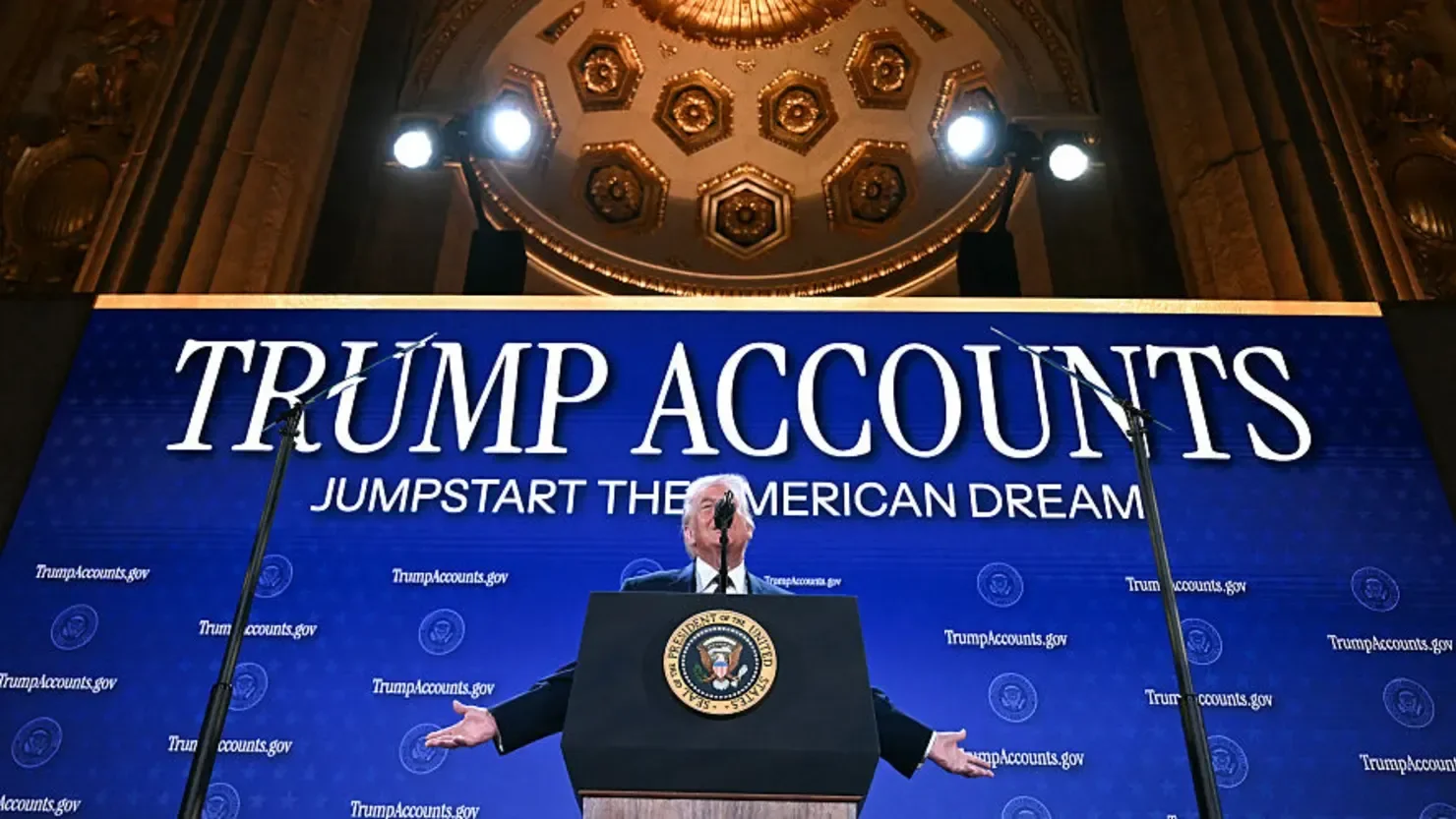
A new federal savings program has quietly become one of the more consequential things to understand if you're raising a young child in the U.S. right now. Created under the 2025 tax law often referred to as the One Big Beautiful Bill Act, Trump Accounts deposit $1,000 into a custodial investment account for eligible children — and by the time the program had been live for about two months, more than six million families had already opened one. Here's what it actually is, how the money grows, and what it means next to the accounts families already know.
What a Trump Account Actually Is
A Trump Account is a new type of custodial traditional IRA (Individual Retirement Account) set up on a child's behalf. It isn't a savings account in the everyday sense — the money is invested, not held as cash, and it follows a modified version of standard IRA rules until the beneficiary turns 18. Congress created the program as part of 2025 tax legislation, and contributions were only permitted starting July 4, 2026, when the program officially went live.
Until the end of the calendar year the child turns 17 — what the law calls the account's "growth period" — no withdrawals are allowed at all. Once the child turns 18, ordinary IRA rules take over: they gain control of the account, and from that point on, they (not a parent) need actual earned income to keep contributing to it.
Who Qualifies, and How to Actually Claim the $1,000
Eligibility is narrower than most coverage implies. A child must be a U.S. citizen with a valid Social Security number, born between January 1, 2025, and December 31, 2028 — a bounded four-year window, not an open-ended "born after 2025" rule. A child born in December 2024, for example, doesn't qualify for the federal deposit at all, even though they'd be starting kindergarten around the same time as a 2025-born sibling.
Just as important: the $1,000 doesn't appear automatically. A parent or guardian has to make an active election on the child's behalf, generally by filing IRS Form 4547 — either during ordinary tax filing or through the online portal at TrumpAccounts.gov. No election, no account, no deposit.
How the Money Grows, and Who Else Can Add to It
Once open, private contributions — from parents, grandparents, or family friends — are capped at $5,000 per child per year for 2026 and 2027 (indexed for inflation afterward). This is a combined cap across everyone contributing, not a separate $5,000 allowance per person. Employers can chip in too, up to $2,500 per employee per year tax-free, and that amount counts toward the same $5,000 ceiling.
One detail worth sitting with: unlike a custodial Roth IRA, which has always required the child to have their own earned income before anyone can contribute, Trump Account contributions during the growth period aren't tied to the child's income at all. A newborn with zero earnings can have a fully funded account — that's specifically what makes it usable for infants and toddlers rather than only teenagers with part-time jobs.
Government agencies and nonprofits can also contribute, but only in equal amounts across an entire eligible group (every child born in a given state or year, for instance), and those contributions don't count against the $5,000 private cap. A handful of large philanthropic pledges have already used this mechanism — the Michael & Susan Dell Foundation, for example, has committed to adding money for children under a set age, and SpaceX president Gwynne Shotwell has pledged company stock for children in lower-income areas. These sit on top of, not instead of, the standard $1,000 federal deposit.
All contributions must go into a genuinely invested position — a mutual fund or ETF tracking a broad U.S. stock index — with annual fees capped under 0.10%, so the money can't simply sit idle in cash.
Robinhood, Then Everyone Else: How the Brokerage Landscape Actually Works
This is where a lot of coverage gets muddled. The Treasury didn't run an open competition among brokerages for the initial rollout — it designated Robinhood as the sole initial broker-dealer and trustee, with Bank of New York Mellon serving as the financial agent handling custody and infrastructure behind the scenes. That means every Trump Account currently starts life on Robinhood's platform, built as a custom app for the Treasury.
What happens next is where the other major brokerages come in. Once a family's account exists, they can do a trustee-to-trustee transfer — tax-free — to an approved outside custodian. Fidelity, Charles Schwab, Vanguard, and Bank of America have all been cleared to receive these rollovers, and each is required to offer a comparable low-cost S&P 500 or broad-market index fund within the same 0.10% fee cap. Fidelity and Schwab have already published rollover guides for families who'd rather consolidate the account with a broker they already use.
Separately — and worth not confusing with the above — several brokerages have also launched their own custodial investing products for minors that exist independently of the Trump Account program. Wealthfront, for instance, launched its own kids' investing account (a standard custodial structure, not a Trump Account rollover destination) around the same time, competing for the same wave of parental attention rather than plugging into the federal program directly.
The Tax Detail Most Explainers Skip
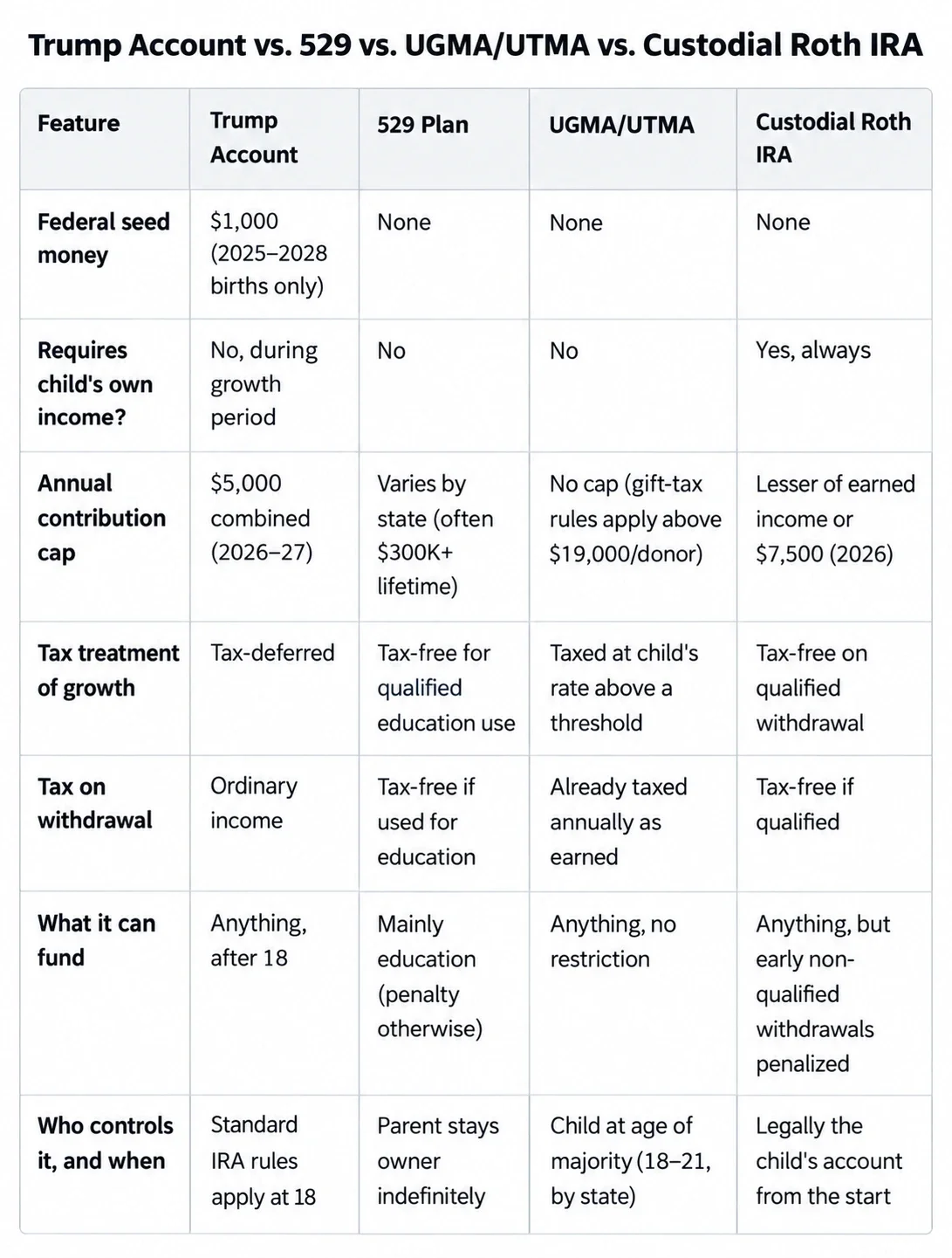
Because it shares the word "IRA" with a Roth IRA, a lot of people assume a Trump Account grows and withdraws tax-free the same way. It doesn't. Contributions go in after-tax, growth compounds tax-deferred while the money stays invested, but withdrawals are taxed as ordinary income — the traditional IRA model, not the Roth model. A 529 plan, by contrast, is genuinely tax-free on withdrawal, as long as the money goes toward qualified education expenses. Whether a Trump Account, a 529, or both makes sense for a given family really does come down to what the money is ultimately for.
The Part No Brokerage Product Solves
Every one of these accounts — Trump Account, 529, UGMA, custodial Roth — solves the same first problem: getting money invested on a child's behalf. None of them solve the second, harder problem: a teenager actually understanding what's happening inside that account by the time they take it over at 18. Knowing the difference between tax-deferred and tax-free growth, understanding why the money sits in an index fund instead of cash, and being able to make a genuinely informed decision the day control transfers to them — that's a separate skill from simply having the account exist.
Frequently Asked Questions
Is the $1,000 really automatic once my child is born?
No. A parent or guardian must actively file IRS Form 4547, either during tax filing or through TrumpAccounts.gov, to elect the account and trigger the deposit — a child born in the eligible window with no election filed won't receive it.
What if my child was born in 2024, just before the eligibility window opened?
They don't qualify for the $1,000 federal deposit, since eligibility is strictly bounded to births from January 1, 2025 through December 31, 2028 — families in this position typically use a 529 plan or a standard UGMA/UTMA account instead.
Can grandparents or family friends contribute directly?
Yes. Anyone can contribute cash to an open Trump Account, though all private contributions from all sources combined are capped at $5,000 per child per year.
Do I have to keep the account with Robinhood?
No. Robinhood is the initial trustee for every new account, but families can transfer the balance tax-free to an approved custodian — currently Fidelity, Charles Schwab, Vanguard, or Bank of America — once they're ready to move it.
Is a Trump Account better than a 529 plan for my child?
It depends on the goal. A 529 is stronger if you're specifically saving for education, since qualified withdrawals are tax-free. A Trump Account is more flexible in what it can eventually be used for, but withdrawals are taxed as ordinary income rather than being tax-free.
What happens if we accidentally contribute more than $5,000 in a year?
Excess contributions generally need to be withdrawn and can trigger an excise tax, so it's worth having one family member track total contributions across everyone giving, especially once grandparents or an employer are involved.
Can a child who isn't a U.S. citizen have a Trump Account?
No — citizenship and a valid Social Security number are required for the federal $1,000 deposit specifically; non-citizen children aren't eligible for this program, though other custodial account types remain available regardless of citizenship status.
Whichever account your family opens, IFA's course on the power of compound interest and Introduction to Investing are built to make sure the teenager attached to that account understands exactly what's happening inside it — including the tax questions above — well before the day it becomes theirs to manage.
This article is for general educational purposes and isn't financial or tax advice. Program rules are still being finalized through Treasury and IRS regulations and may change — confirm current details with a licensed financial advisor or directly at TrumpAccounts.gov before making contribution decisions.
Sources: Internal Revenue Service; Congressional Research Service (Congress.gov); U.S. Treasury and SEC regulatory filings; Bipartisan Policy Center.