Diamond Challenge 2027 Registration Opens September 16: Your Complete Prep Timeline
Key Takeaways
Submission window opens: September 16, 2026
Submission deadline: January 14, 5:00 PM EST
Advancing teams notified: February 10 | Finalists announced: March 9
Limitless World Summit (finals): April 29–30, 2027 — in-person attendance required
Prize pool: $100,000+, including five additional topical awards beyond the grand prizes
Eligibility: High school students aged 14–18 at the submission deadline, teams of 2–4, one adult advisor (21+), free to enter
Two submission stages, two different video formats — a 60-second intro video first, a 5-minute pitch video only if you advance
Submissions for the 2026–2027 Diamond Challenge open September 16, giving high school teams worldwide until January 14 to turn an idea into a fully submitted venture concept. Run as a philanthropic education initiative by Horn Entrepreneurship at the University of Delaware, it's one of the largest and most accessible entrepreneurship competitions a teenager can enter — free, open to any student aged 14 to 18, and built around a genuinely rigorous but achievable two-stage process. Here's exactly how it works, based on the competition's own official rules.
The Official 2026–2027 Timeline
September 16 — Submission window opens
January 14, 5:00 PM EST — Submission deadline (written concept + intro video)
February 10, 11:59 PM EST — Advancing teams notified
March 9 — Finalists announced
April 29–30, 2027 — Limitless World Summit (final round)
Four months between opening and deadline is enough time to develop a genuinely strong concept — but every one of those dates is strict. Submissions are final the moment they're uploaded, and there are no stated exceptions for late entries.
Who Can Compete: Eligibility and Team Rules
Teams of 2 to 4 high school students, aged 14–18 at the submission deadline (not at registration — a student who turns 19 between September and January could be disqualified, so check this carefully for older juniors and seniors)
One adult advisor required, aged 21 or older. Multiple advisors can help behind the scenes, but only one can appear on the official submission
Each student may join only one team and submit one concept per competition year
Full contact information, including email, is required for every team member and the advisor
Choosing Your Track: Business Innovation vs. Social Innovation
Every team locks in a track at submission — the choice is final once you submit, so this isn't a decision to make lightly.
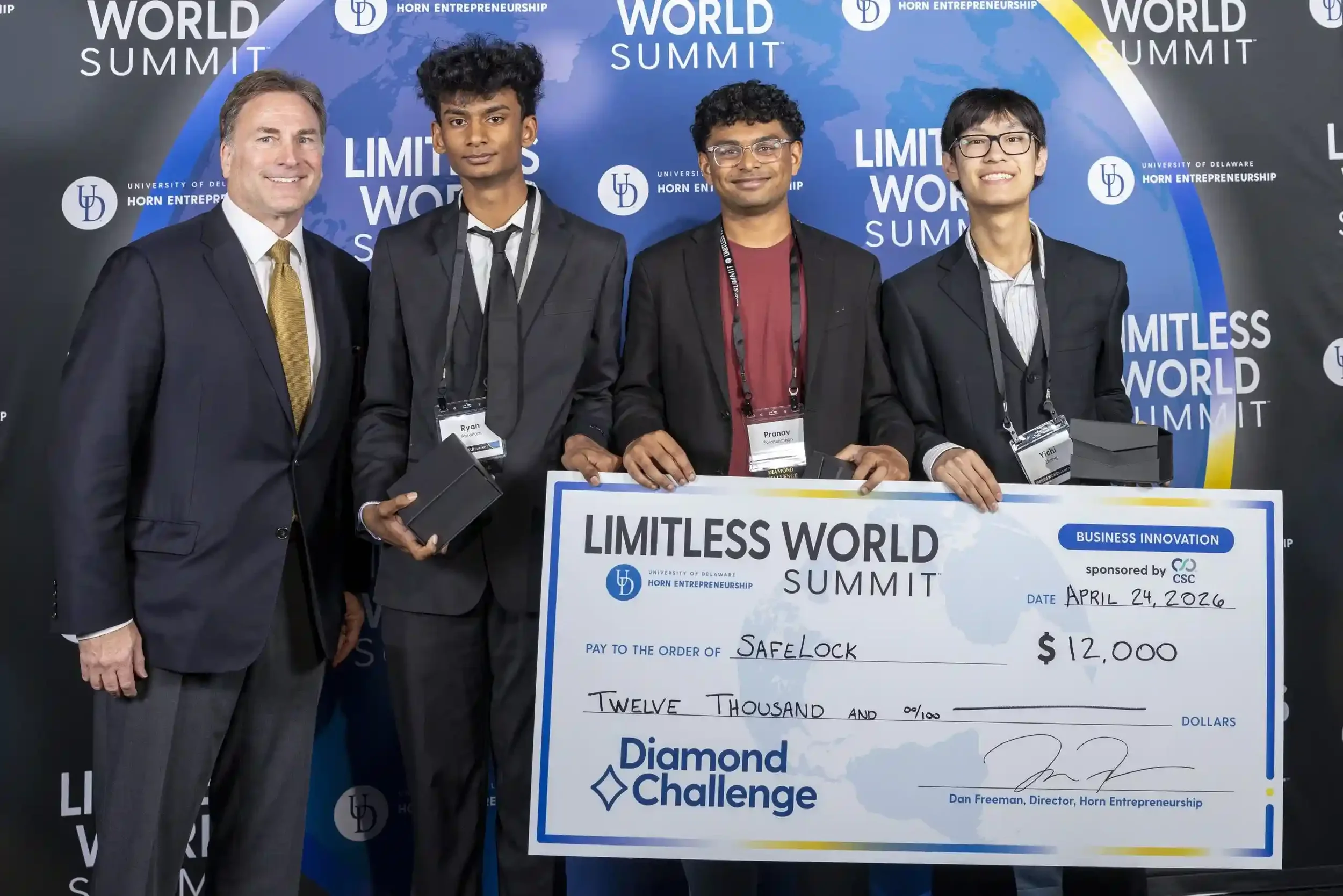
Business Innovation concepts exist primarily to solve a customer problem in a way that generates revenue and profit. The 2026 first-place Business Innovation team, SafeLock, built a fingerprint-protected gun lock with real-time app tracking — a clear commercial product solving a specific, well-defined problem.
Social Innovation concepts exist primarily to solve a social or environmental problem and create positive impact. The 2026 first-place Social Innovation team, Evion, built a low-cost AI crop-health platform for small and mid-size farms — impact-driven, but still grounded in a real, usable product.
Neither track is the "easier" option. Both are judged on how convincingly the team can prove the idea actually works.
What You Actually Submit: Two Very Different Stages
This is the part most guides get vague on, and it matters — the two stages of the Diamond Challenge require genuinely different materials.
Stage One: Written Concept + 60-Second Video (by January 14)
The written concept narrative is 3–5 pages, double-spaced, 12-point font, 1-inch margins, submitted as a PDF with no cover page — pages beyond the limit are simply removed before judging, so editing down is not optional. It needs to tell one continuous story: the problem, who has that problem, how the concept solves it, why it's better than existing alternatives, the basic economics of how it makes money (or sustains itself, for Social Innovation), what the team brings to executing it, and any real evidence or early traction gathered so far.
Alongside it, teams submit an introductory video strictly limited to 60 seconds — not five minutes, a common point of confusion. This video only needs to introduce the team, the concept name, and a brief version of the problem and solution. Anything longer is disqualified automatically.
Stage Two: The Five-Minute Pitch (if you advance)
Teams that clear the minimum judging score move to the pitching round, choosing either a live pitch event (hosted by partner organizations at locations worldwide) or a pre-recorded virtual pitch — this choice is also locked in at initial submission. Either way, the pitch itself is strictly 5 minutes, built around a recommended 15-slide deck, followed by a 3-minute judge Q&A that only participating students (not the advisor) may answer.
If You Reach the Summit, It's In Person
Finalists are invited to the Limitless World Summit — and at least one team member must attend in person to compete; there's no fully virtual option at this stage. If a visa application is denied or delayed, teams can request a one-year deferment, but only once. For families applying from outside the US, this is worth planning for from day one rather than discovering it in March — start any visa paperwork as soon as your team advances, not after finalists are announced.
How Judges Actually Score Your Concept
Business Innovation is judged on an equal weighting of feasibility, growth potential, and a "wow factor" — originality, storytelling, and passion.
Social Innovation is judged on an equal weighting of feasibility, sustainability, social impact, and the same "wow factor."
"Feasibility" carries real weight in both tracks — judges are specifically evaluating whether a team of teenagers could plausibly execute the idea, not just whether the idea sounds good.
What Winning Actually Looks Like: The 2026 Grand Prize Concepts
Seeing real winners is more useful than any generic advice. From the 2026 Summit:
Business Innovation — SafeLock (fingerprint-protected gun lock with app-based tracking), SpotShield (an adhesive shield protecting athletes from unexpected menstrual leakage), SilicaForge (a transportable device converting desert sand into concrete).
Social Innovation — Evion (AI crop-health platform for small farms), St. Martins Apparel (sustainable bags paired with entrepreneurship education for underprivileged youth in the Philippines), Pipes for the People (bagpipe music programs empowering youth with cystic fibrosis).
Notice what these have in common: every one solves a specific, narrow, clearly-stated problem — none of them are broad ideas like "an app to help teens save money." Specificity wins.
Beyond the Grand Prize: Five Topical Awards
On top of the $12,000 / $8,000 / $4,500 grand prizes awarded per track, sponsor-backed topical prizes recognize teams with expertise in a specific area, regardless of their overall placement: a Waste & Recycling Innovation Prize (Delaware Solid Waste Authority), an Innovation Excellence Prize for technology improving lives (Gore), a Pathways to Prosperity Prize for economic-access solutions (Capital One), a Global Prize for standout entrepreneurial spirit (Horn Entrepreneurship), and a Human Flourishing Award for mental health, education, and wellbeing concepts (The Soundboard Impact Foundation). A concept that doesn't place in the top three can still win one of these — worth keeping in mind when choosing a problem to solve.
Where in the World You Can Pitch
Live pitch events run through partner organizations across more than 20 locations, including India, Armenia, Canada, China, Greece, Guatemala, Haiti, Japan, Liberia, Morocco, Nigeria, Panama, Sweden, Thailand, and several US states. Students who'd rather not travel to a regional event can choose the virtual/pre-recorded pitch option instead — both routes are judged identically at the pitching-round stage.
A Realistic Four-Month Prep Plan
With submissions due January 14, a workable pace from a September start looks like:
Weeks 1–3: Identify and validate the problem — talk to real potential customers or beneficiaries before writing anything
Weeks 4–7: Build the solution and business model, including the "basic economics" the narrative requires
Weeks 8–11: Draft and tighten the written narrative to fit the 3–5 page limit — this usually takes more rounds of cutting than writing
Weeks 12–14: Script, shoot, and edit the 60-second intro video — treat the 60-second cap as a writing exercise, not an afterthought
Final week: Full read-through against every submission rule before uploading
Teams that skip early customer validation are, consistently, the ones whose written narratives read as guesswork rather than evidence — and "evidence gathered" is explicitly part of what the narrative is judged on.
Five Mistakes That Sink Strong Concepts
Treating the 60-second video as a rough draft. It's disqualified outright if it runs long — script it to the second before recording.
Writing past the page limit and hoping it won't matter. It does — pages beyond five are physically removed before a judge ever reads them.
Picking a pitch format without thinking it through. Live and virtual are judged the same way, but the choice locks in at submission — decide based on your team's actual comfort and logistics, not a guess.
Assuming Summit attendance is optional if you make finals. It isn't. At least one team member must be physically present, and international teams need visa lead time.
Disclosing the school name when it isn't essential to the concept. The rules explicitly discourage this outside of cases where the school is core to the idea itself.
Frequently Asked Questions
Is the Diamond Challenge free to enter?
Yes, there's no registration or submission fee anywhere in the official rules — the only costs a family might incur are travel-related, and only if the team advances to an in-person pitch event or the Summit.
Can our team change its track or pitch format after submitting?
No. Both the competition track (Business or Social Innovation) and the pitch format (live or virtual) are selections the rules describe as final upon submission, so they're worth deciding deliberately before the January deadline rather than defaulting to whatever feels easiest that week.
Does every finalist have to travel to the Summit in person?
Yes — at least one team member must attend in person to compete for the final prizes; there is no remote option at the finals stage. Teams facing visa delays can request a one-year deferment, but only once.
Who actually receives the prize money?
Awards are paid either to the team's registered venture (if it's a formally registered entity) or split evenly among registered team members if the team can't agree on another arrangement.
Can a middle schooler apply?
No — eligibility is strictly high school students aged 14 to 18 at the submission deadline, not simply at the time of registering.
What if our internet or tech fails during a live pitch?
The 5-minute clock doesn't stop for technical issues, so the official rules specifically advise teams to prepare a backup plan rather than assume perfect conditions.
This guide is based on the Diamond Challenge's official published rules for the 2026–2027 season. Rules can be modified by the Diamond Challenge leadership team at any time — always confirm current details at diamondchallenge.org before submitting. IFA provides independent competition preparation and is not affiliated with Horn Entrepreneurship or the University of Delaware.
If your team wants a structured hand on this — from problem validation through mock pitch rounds — IFA's championship prep programme is built around exactly these two submission stages, starting with a free readiness assessment.